- (951) 419 4206
- info@cafinestpools.com
- License: CSLB#1148412

Smooth again, bright again
A surface you can walk on barefoot, water that goes back to being bright blue, and a pool that looks like it was finished last year. The old plaster comes out properly rather than getting covered over — which is why ours lasts a decade instead of a couple of seasons.
(951) 419-4206Free estimates. Financing available. Licensed — CSLB #1148412.
Run by Oscar Retana, twenty-one years plastering pools in Southern California, with his sons on the same crew. One fixed price in writing before anything is demolished.
Where we work most: Riverside, Redlands, Hemet, Murrieta, Corona and Anaheim — and across five counties: Moreno Valley, Temecula, Menifee, Rancho Cucamonga, Ontario, Fontana, Chino Hills, Irvine, Orange, Pasadena, Glendora, Whittier, Carlsbad, Oceanside, Vista and everywhere in between.
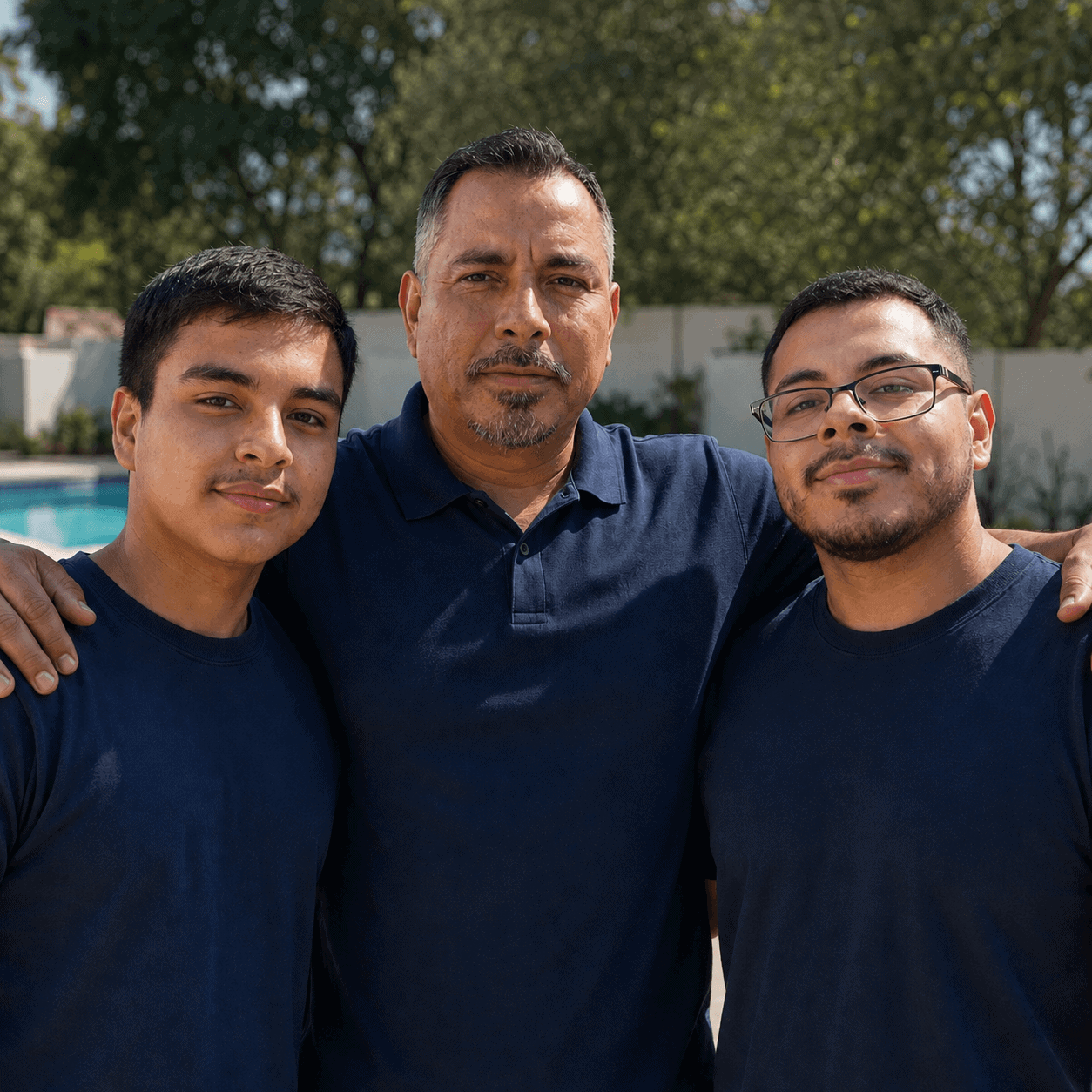
Oscar Retana and his sons — the crew that will be in your backyard. CA’s Finest & Quality Pool Plastering Inc, Riverside County.
Who will be in your backyard
“Plaster is not complicated. It is just unforgiving. You get one pour and it remembers everything you did that day.”
It is in the company name because it is what we do. Twenty-one years and more than a hundred pools, and Oscar still works alongside his own sons — the same three or four people are in your backyard from the day the old surface comes out to the day the water goes back in.
That matters more on plaster than on almost anything else, because the interior finish goes on in one continuous pour. There is no stopping halfway, no second shift, no coming back tomorrow to blend it in. The crew that starts your pool finishes it that same day, and they are people who have done it together for years.
And it is the reason the work holds. We do it the way we would want it done at our own house, because it is our own name on it.
You will have Oscar’s number, in English or Spanish, whichever you prefer.
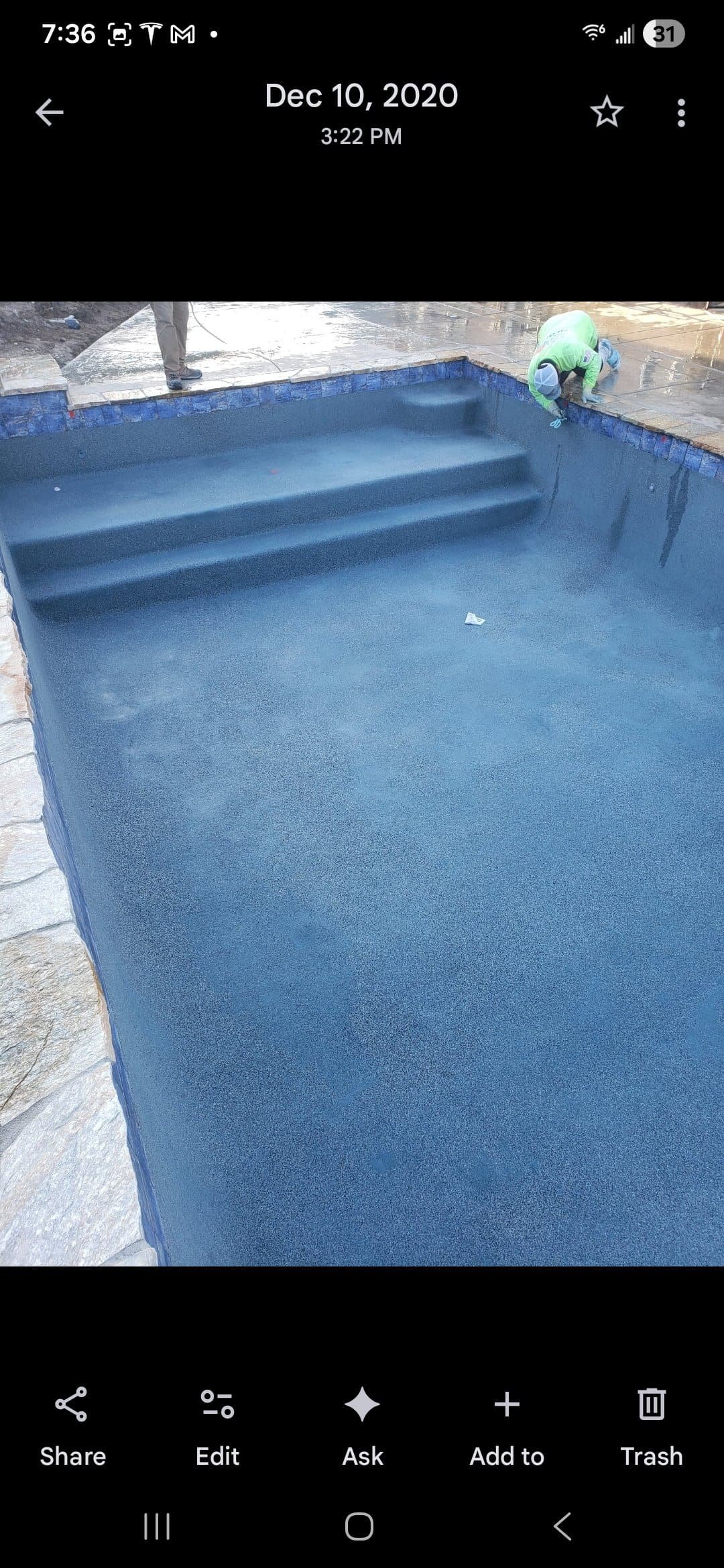
Three materials, one job
Same labour, three different materials. This is where your water colour and your next decade get decided, and it is the part of the estimate people enjoy.
Cement and white marble aggregate — the classic pool interior and still the most popular in California. Smooth underfoot, bright blue water, and the most affordable way to make a tired pool look new again.
Eight to twelve years of life when the chemistry is kept in range, and it suits almost any backyard.
the most affordable finish
White plaster with quartz aggregate blended in. Harder, noticeably better at shrugging off stains, and it holds its colour longer — while staying as smooth underfoot as plain plaster.
More than white, less than pebble. For a lot of families it is the sweet spot, and it is worth asking about at the estimate.
the middle option, often the right one
Deep blues, greys and greens, and it is striking on the day it fills.
One honest note, because almost nobody gives it: pigmented cement commonly mottles within two to three years. That is how the material behaves, not bad workmanship — but you should hear it before you choose, not after. If you want dark water that holds, a pebble finish is the way to get it.
we will show you both
We bring real samples to the estimate so you can hold them, see them in your own daylight and put them next to your coping and your deck. A chip under a showroom light is a poor guide to what twenty thousand gallons of water will look like in your backyard.
And if the waterline tile is looking dated too, say so — replacing it while the pool is already drained costs a fraction of doing it later, and it is the single most visible change per dollar in the whole project.
Our testimonials
Hear it from the people whose backyards we worked in. Then read the reviews straight from our Google profile, below.
A customer on how the job went, start to finish.
Another customer, another backyard in Southern California.
Every one of them written by somebody whose pool we worked on, in Riverside, San Bernardino, Orange, Los Angeles or San Diego county. Several are in Spanish, because a good share of our customers are.
We would rather you read them before you call us than after.
Why ours lasts a decade
It is the least glamorous thing on this page and it is the one that decides everything.
New plaster is only ever as good as what it is bonded to. So before anything else happens, the old surface comes off the shell completely — chipped out, loaded up and hauled away in our truck — and the gunite underneath gets inspected and prepared properly.
Then the new plaster bonds to the shell the way it was designed to. That is the whole reason a job like this gives you eight to twelve years.
There is a shortcut, and it is worth knowing it exists. Google even asks the question: can you plaster over old plaster? You can — it is called a bond coat, and on a pool whose existing surface is genuinely sound everywhere it is a legitimate method.
But after ten or fifteen years of Southern California sun and hard water, some part of the old layer is usually letting go. New plaster laid over it is glued to something that is already releasing, and that tends to show up around year two or three — at which point both layers have to come out anyway.
So we chip out. It is more labour, more noise and a day of debris in your driveway. It is also why you will not be calling anybody about this pool again for a decade. And if your pool genuinely is a good candidate for a bond coat, we will tell you that too — we would rather you have the facts than the bigger invoice.
“Is the old plaster coming out, or is the new one going over it?”
It is a fair question, every contractor should be able to answer it in one sentence, and the answer explains most of the difference between two prices that look far apart.
Ask us the same thing. Chipping out, hauling the debris away and preparing the shell are line items in our written quote, so you can see them rather than take our word for it.
What it costs
We quote by linear feet of perimeter — the distance around the edge of your pool, not square feet and not gallons. It is the only unit that matches the work, which is also why we measure before we price.
From $7,800
Demolition and a regular white plaster finish on a typical pool starts around $7,800 — the old surface chipped out and hauled away, the shell prepared, and the new plaster on. Quartz plaster is a step up from there, and mini pebble starts closer to $10,500, because the material costs more and lasts considerably longer.
From there it moves with what you decide to include. New waterline tile and coping are real improvements and neither one is required to replaster — but both are far cheaper done now, while the pool is already drained, than as their own job in three years.
These are approximate starting figures for orientation only. They are not a quote and they are not a price promise. We do not publish a rate per foot, because the honest answer is that it is not the same in every city — and a number on a web page that turns into a different number at your house helps nobody. You get one fixed number in writing after Oscar has come out and measured it, free, and it does not move afterwards.
Financing is available. Ask about it when you call — it is worth knowing your options before you pick the finish rather than after, because the gap between plaster and a longer-lasting material is usually smaller than people expect once it is spread out.
Draining, chipping out the old surface, hauling the debris off your property, preparing the shell, the new plaster, and the fill. The price is fixed in writing before the first hammer. If we open something up and find a problem, you get a photo and a price, and nothing happens until you say yes.
Because the job is not the same in every city. Access is the big one — a backyard we can reach with a truck is a different day of work than one where every load of debris goes out through a side gate by hand. Beyond that, material costs more in some markets than others, and the drive matters when a crew is on your property for a week.
Anybody who gives you a flat per-foot price over the phone without asking where you live is either quoting high to cover themselves or is going to find a reason to revise it later. We would rather tell you where it starts now and give you the real number after we have seen the pool.
We do not hand you the keys and drive off
New plaster is still curing while the pool fills, and those fourteen days do more for how long it lasts than anything else you will ever do to it. So we stay on it with you.
We start the fill ourselves and we do not stop it, because an interrupted fill leaves a line at the waterline that never comes out.
Then we walk you through the brushing — twice a day, the whole surface — which is what keeps the plaster dust moving instead of settling into your brand-new finish. And we tell you exactly what the water chemistry should look like in week one and in week two, because fresh plaster is far less forgiving than cured plaster.
All of it is written down and handed to you on fill day. You are not expected to remember a conversation you had standing next to a hose.
And if you have a weekly pool service, tell us who they are. We will call them ourselves about the start-up — a pool tech treating a two-day-old surface like a normal pool can undo the whole job without ever knowing it, and that conversation is better had between the two of us than passed through you.
Get this fortnight right and the surface rewards you for a decade. That is why we are still there for it.
Written down and handed to you on the day we fill it.
What happens, in what order
Five steps. You hear from Oscar on every one of them.
Step 1
Free, at your house. We measure the perimeter, check the condition of the existing surface and bring samples you can hold in your own daylight.
Step 2
The plaster, any tile or coping, what is included and what is not. You keep a copy before anybody picks up a chipping hammer. Ask about financing here.
Step 3
The pool is drained and the old plaster comes off — all of it. The debris leaves in our truck. If the shell underneath needs anything, you see a photo first.
Step 4
The shell is prepared and the new plaster goes on in one continuous pour. It is a one-day operation and it does not get split across a weekend.
We start the fill the same day the plaster goes on and we do not stop it. Then the two weeks of brushing and chemistry described above, in person and on paper.
Chip out and plaster only: about one week. That is the straightforward replaster and it is most of what we do.
With new tile, new coping or anything structural: up to a month, because each of those adds days of its own. We tell you which one yours is at the estimate.
There is a table on our services page that matches what you are seeing — chalky residue, staining, a rough surface — to what it usually turns out to be, including when the answer is that you have a couple of seasons left.
If something fails because of our workmanship within the first year, we come back and repair it. No cost, no argument — and it is in writing before we ever start, not promised verbally at the door.
Real work, real results
No stock photography — every project shown here is one of ours, in a real backyard around the Inland Empire.
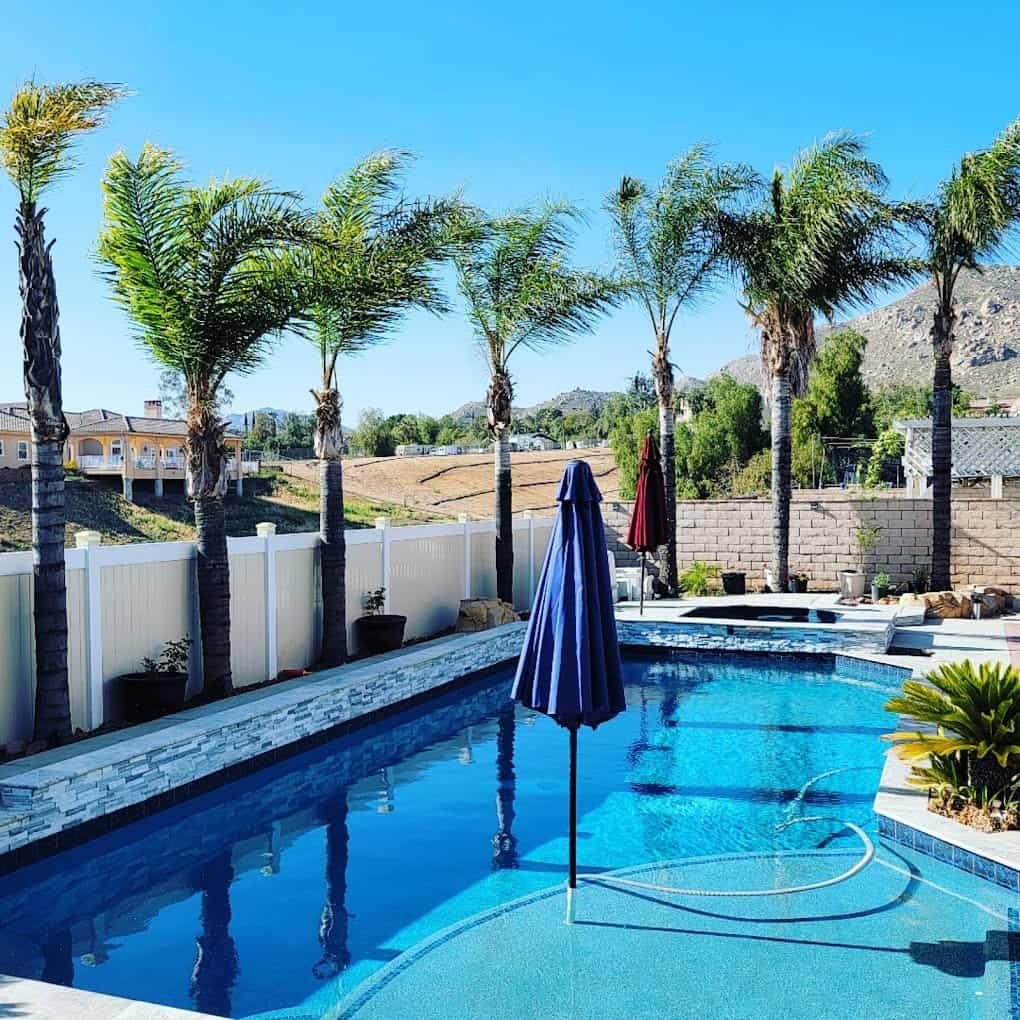
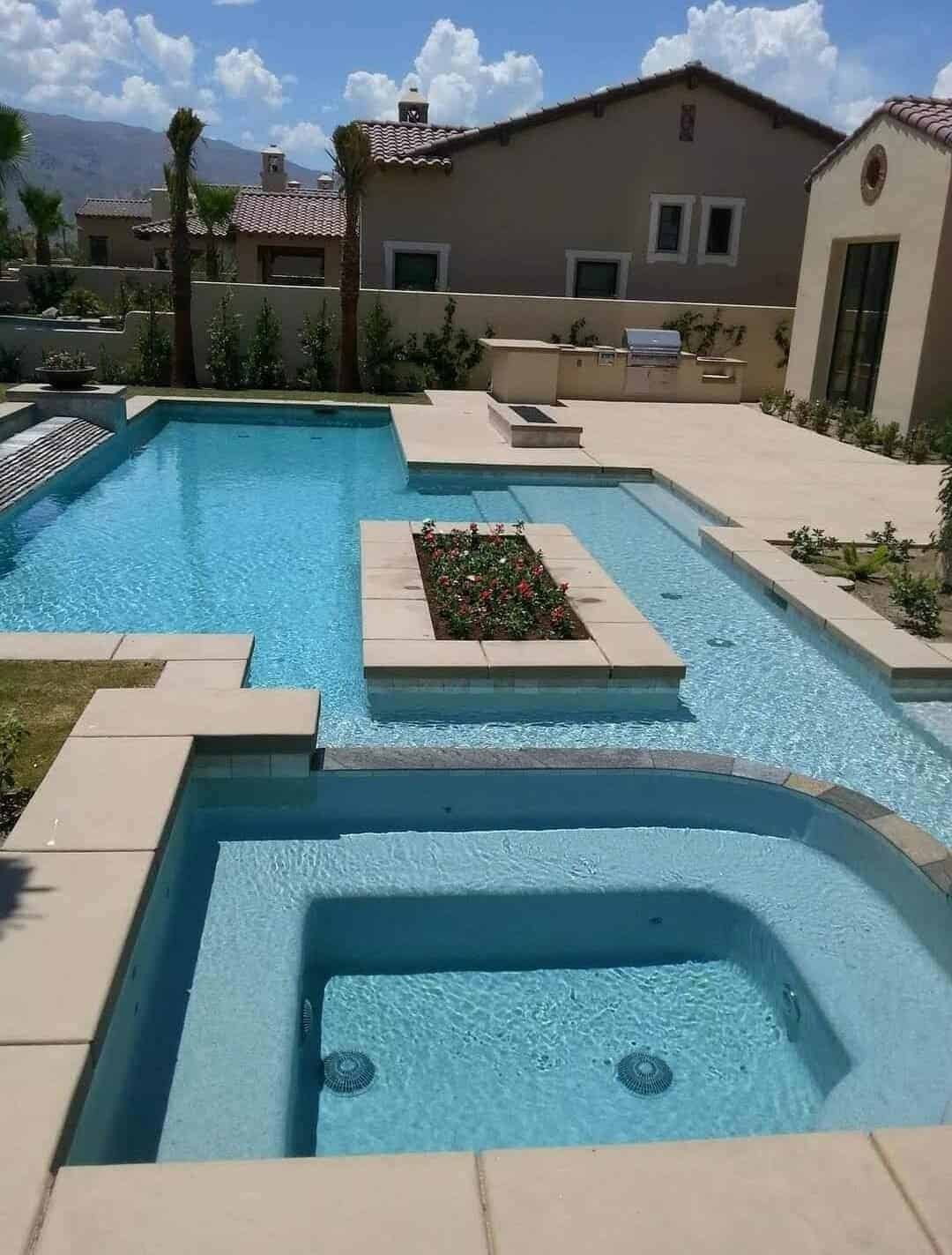
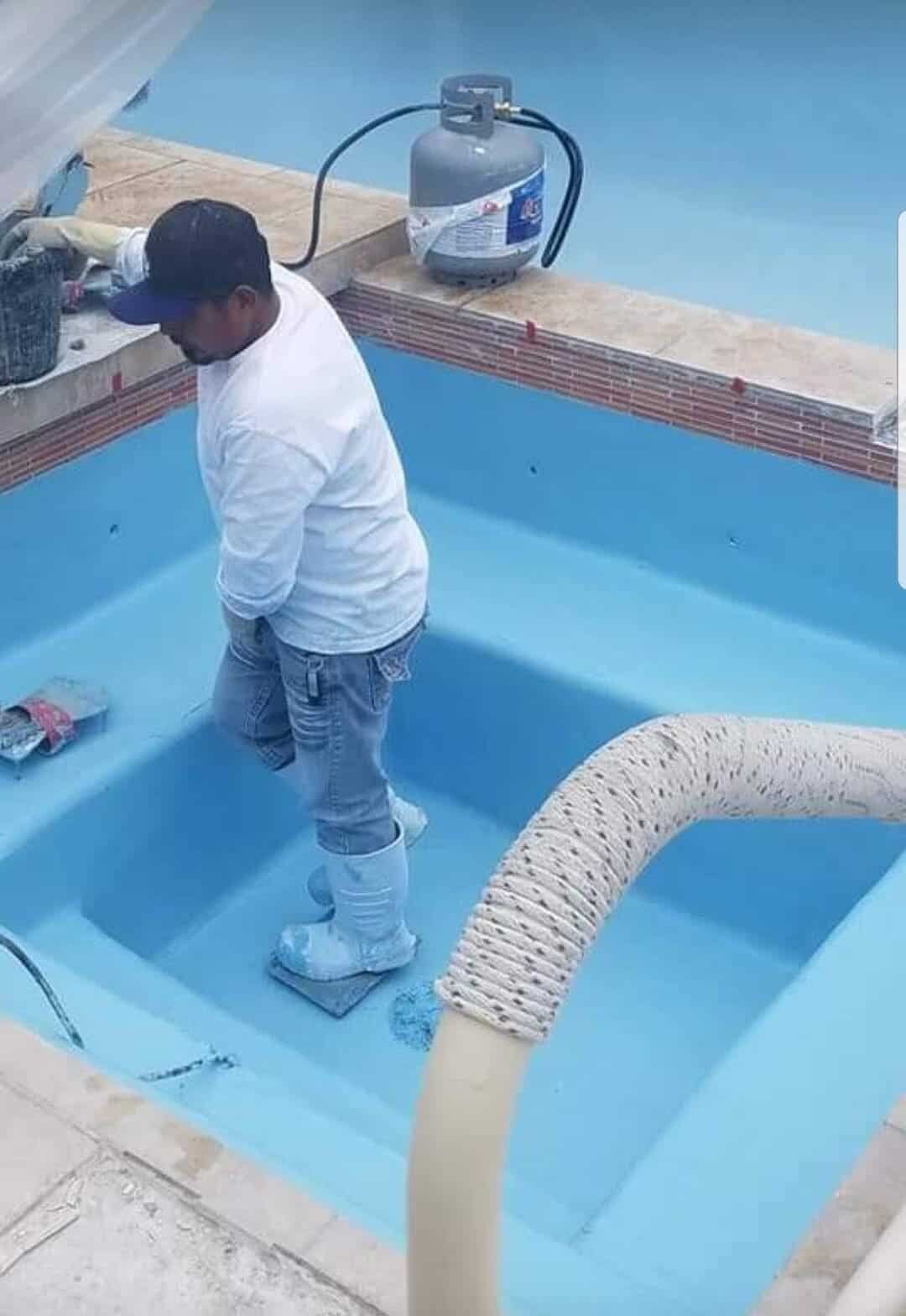
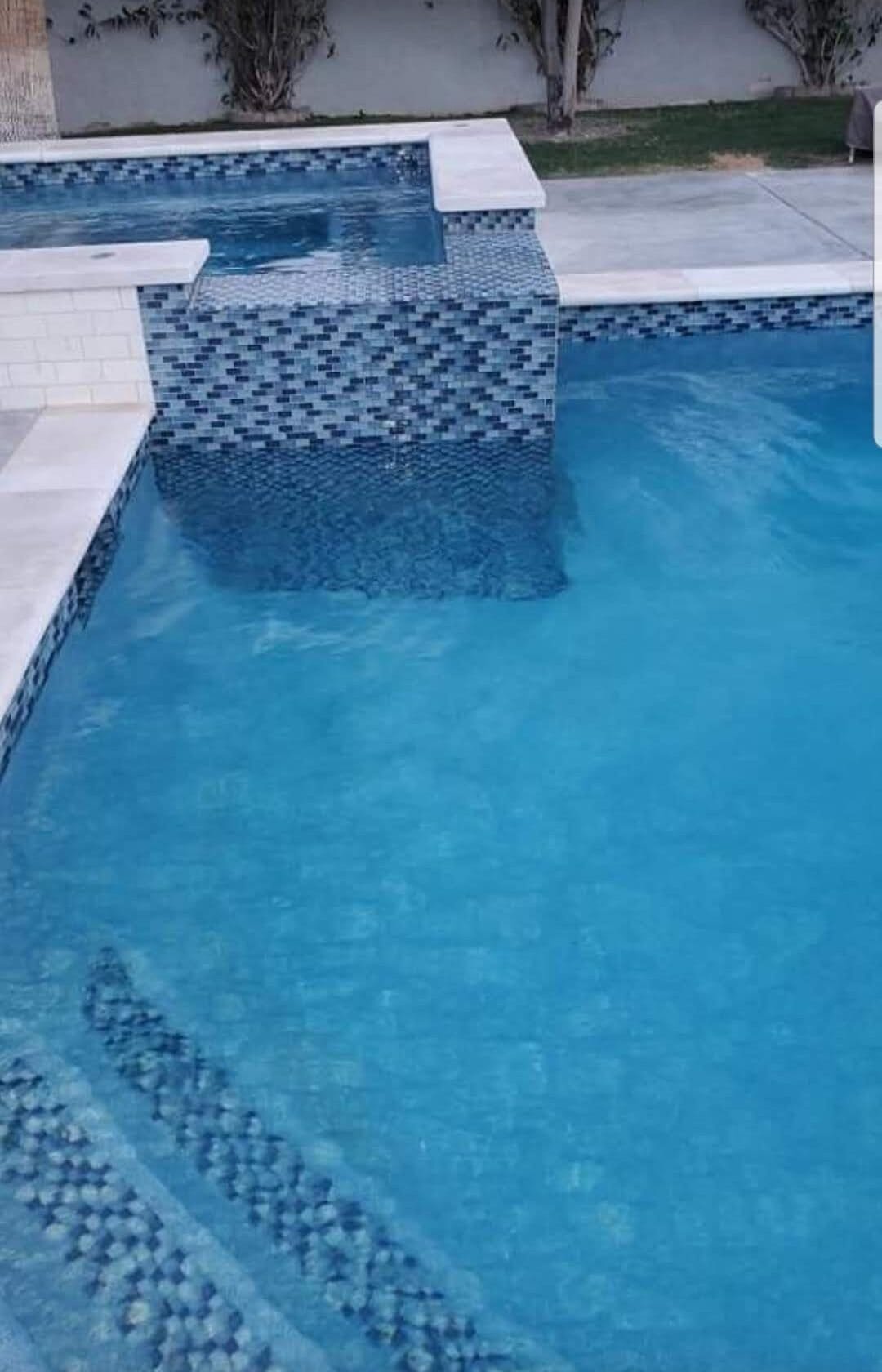
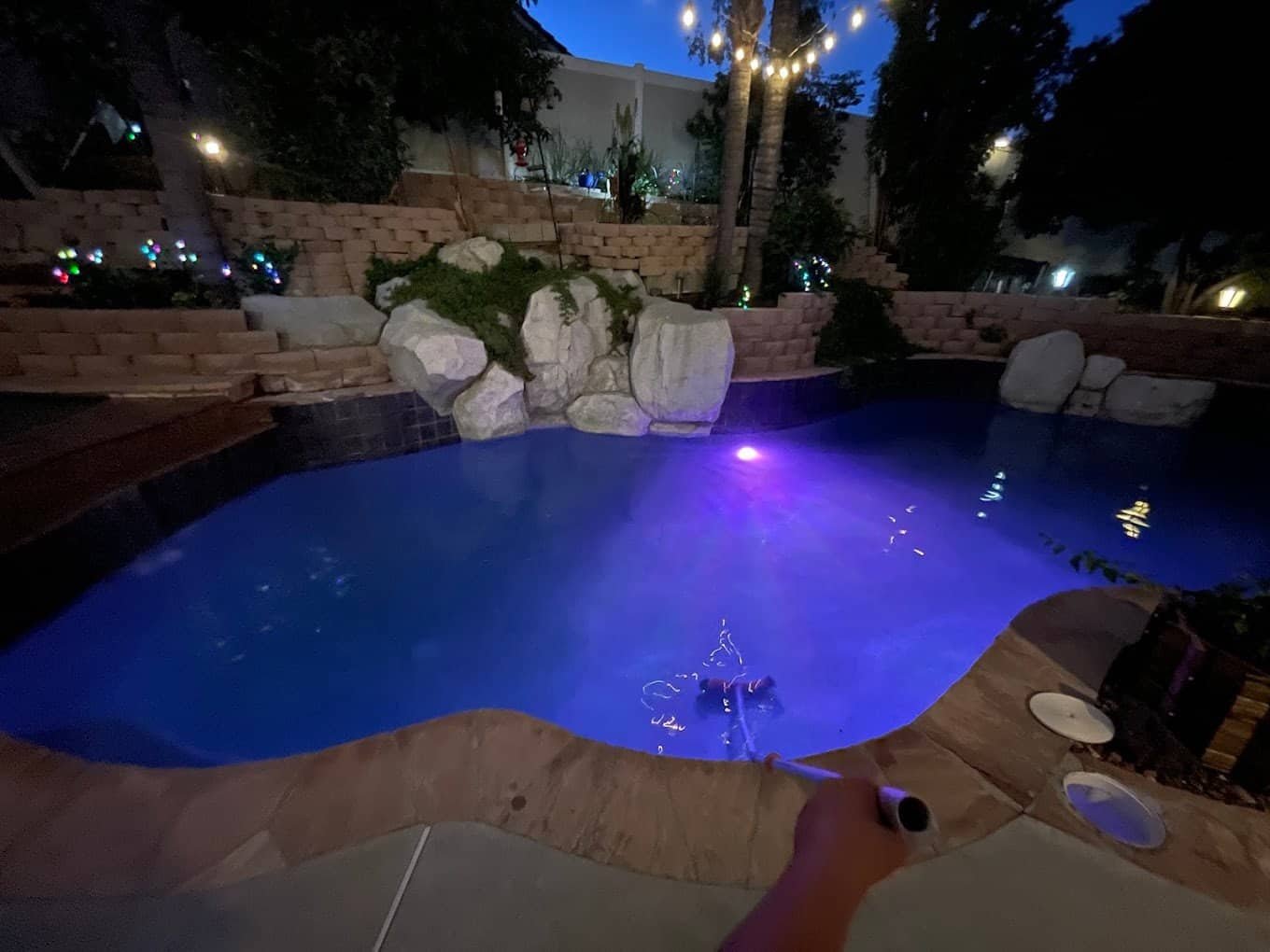
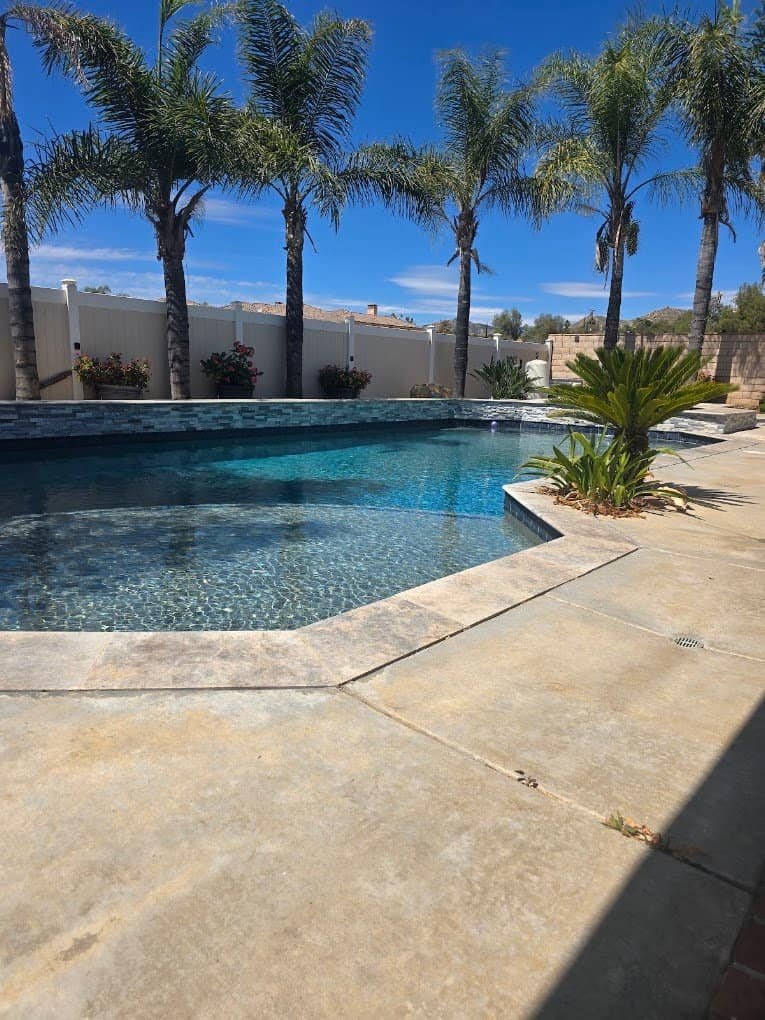
For every new customer, on top of whatever the quote already says — your first pool remodeling or new pool construction project with us. Veterans and active-duty military, always. And ask about financing while you are at it. Just mention it when you call.
Where we work
We are based in Riverside County and we replaster pools across five counties. Most of these pools went in between the late seventies and the nineties, which means an enormous number of them are on their original plaster or close to it.
Riverside, Hemet, Murrieta, Corona, Moreno Valley, Temecula, Menifee, Perris, Lake Elsinore, Eastvale
Redlands, Rancho Cucamonga, Ontario, Fontana, Chino Hills, Upland, Rialto, Highland, Yucaipa
Anaheim, Irvine, Orange, Yorba Linda, Fullerton, Tustin, Brea, Villa Park
Pasadena, Glendora, Whittier, Claremont, San Dimas, La Verne, Arcadia, Covina
Carlsbad, Oceanside, Vista, San Marcos, Escondido, Encinitas, Fallbrook
The practical questions
The first six are the ones Google itself shows when you search pool replastering anywhere in Southern California.
Gallons are the wrong unit for this, and knowing that will help you compare quotes. Replastering is work done on the walls and floor, so what matters is the perimeter — not the volume. Two pools can both hold 30,000 gallons and have very different perimeters depending on shape and depth.
That said, demolition and a regular white plaster finish on a typical pool starts around $7,800 — the old surface chipped out and hauled away, the shell prepared, and the new plaster on. The same pool in mini pebble starts closer to $10,500.
That is an approximate starting figure for orientation only, not a quote and not a price promise. Your number comes after Oscar has seen the pool, because the city, the shell underneath and the access all move it. The visit is free and the price is fixed in writing.
Physically yes. It is called a bond coat, and on a pool whose existing plaster is completely sound it is a legitimate method.
The trouble is that after ten or fifteen years in Southern California, some part of the old surface is usually letting go — and new plaster is only as secure as the layer it is bonded to. When it fails it comes off in sheets, usually around year two or three, and then both layers have to be chipped out anyway.
We chip out. It is more labour, more noise and more debris, and it is the reason the job lasts a decade instead of a couple of seasons. If a quote you are comparing is dramatically cheaper than the others, one question sorts it out: is the old plaster coming out, or is the new one going over it?
White plaster, eight to twelve years in Southern California. Quartz plaster, longer. Pebble finishes, fifteen to twenty.
Two things decide where in that range you land. The first is whether the old surface was chipped out or covered over. The second is water chemistry, which matters more than any other single factor — and it is exactly why we walk you through the first two weeks rather than handing over a full pool and leaving.
Most Southern California pools need replastering somewhere between ten and fifteen years, and the hard water through the Inland Empire tends to push that toward the shorter end.
It rarely fails all at once. It goes chalky first — you rub the wall and white residue comes off on your hand. Then it gets rough underfoot as the top layer erodes. Then the staining starts, because a porous surface holds onto minerals and dirt, and that is usually the point where acid washing stops helping.
If your pool is doing the first two and not the third yet, you may well have another two seasons. Send us a photo and we will tell you honestly which stage you are at.
In everyday use they mean the same job, and most contractors use them interchangeably — including us.
Precisely: resurfacing is the category, meaning any job that removes the old interior finish and applies a new one. Replastering is resurfacing where the new finish is plaster. Putting on a pebble finish is also resurfacing, but it is not replastering.
It matters when you are comparing quotes, because two contractors can both write “resurfacing” and be pricing completely different materials. Ask which finish is in the number.
It depends on your city, and we find out before anything starts. Requirements are not the same in every jurisdiction — some cities treat a replaster as a repair to an existing finish, and others ask for a permit on it.
What is consistent is that anything structural is reviewed: modifying the depth, altering the shell, or reworking plumbing or electrical. Some cities also regulate how the drained water is discharged.
We check what applies to your address and tell you at the estimate. If a permit is needed we handle the filing, and you get that timeline in writing separately so you always know which part of the schedule is ours.
Yes. Ask about it when you call and we will walk you through the options.
It is worth asking before you pick the finish rather than after. The gap between plaster and a longer-lasting material is usually smaller than people expect once it is spread out, and plenty of people end up with the surface they actually wanted simply because they asked early.
Not quite yet — new plaster stays chemically active for around two weeks while it cures, and it is soft enough in the first days to mark permanently.
We tell you the exact date. It is usually somewhere between one and two weeks depending on how the chemistry settles, and waiting for it is the cheapest thing you will ever do for the life of that surface.
No, and it is worth understanding the difference because it is the most common confusion we run into.
An acid wash strips a thin layer off the plaster you already have, taking the stains with it. On a surface with plenty of thickness left it is a reasonable, inexpensive way to buy a few years, and if that is your situation we will say so.
On a surface that is already thin, chalky or flaking, it removes some of the little that remains. That is why an acid wash that helped five years ago does nothing now. If your plaster is at that stage, the money is better spent replastering once than acid washing twice.
You get a photo of it and a price for it, and nothing happens until you say yes. That is the whole policy.
It is not common, but it happens: a crack in the gunite, a bad previous repair, a plumbing fitting that should not be buried again. Finding it is the normal part of the job. What matters is that it never becomes a bill you did not agree to.
Yes — a written one-year warranty on the finish, handed to you with the paperwork rather than promised verbally.
We are also a licensed California contractor, CSLB #1148412. You can look that number up at cslb.ca.gov and see the license status yourself in about thirty seconds. We would encourage you to do that with every contractor who quotes you, including us.
Sí. Oscar y su equipo hablan español. Llame, escriba o mande fotos en el idioma que prefiera y le contestamos en el mismo.
Send a photo of the pool, close enough that we can see the texture. That is usually all it takes for us to tell you whether you are due and what it would run. Free estimate, fixed price in writing, financing available.