
The edge you actually touch
Pool Tile & Coping Replacement in Southern California
A coping you can still stand on barefoot in July, and a waterline band that makes a plain pool look like it was designed on purpose. It is the least expensive change you can make to a tired pool and by far the most visible.
(951) 419-4206Free estimates. Financing available. Licensed — CSLB #1148412.
Run by Oscar Retana, twenty-one years setting tile and coping on Southern California pools, with his sons on the same crew. One fixed price in writing before anything comes off.
Where we work most: Riverside, Redlands, Hemet, Murrieta, Corona and Anaheim — and across five counties: Moreno Valley, Temecula, Menifee, Rancho Cucamonga, Ontario, Fontana, Chino Hills, Irvine, Orange, Pasadena, Glendora, Whittier, Carlsbad, Oceanside, Vista and everywhere in between.

Oscar Retana and his sons — the crew that will be in your backyard. CA’s Finest & Quality Pool Plastering Inc, Riverside County.
Who will be in your backyard
Tile and coping is hand work
“The waterline is the one strip of the pool that is at eye level. Every cut on it shows, forever.”
There is no machine for this. Every tile is set by hand, every piece of coping is laid and levelled by hand, and the difference between a good job and an average one is visible from across the yard for the next fifteen years.
Oscar has twenty-one years of it, and his sons work alongside him — the same three or four people from the first tile to the last. Nobody gets handed off to a crew you have never met.
On this job in particular that matters, because the waterline sits at eye level. A corner cut badly, a grout line that wanders, a stone set a few millimetres proud of its neighbour — those are the things you notice every single time you walk past, and they are the things that only get right when the person doing them is the person whose name is on the truck.
You will have Oscar’s number, in English or Spanish, whichever you prefer.
The thirty-second test
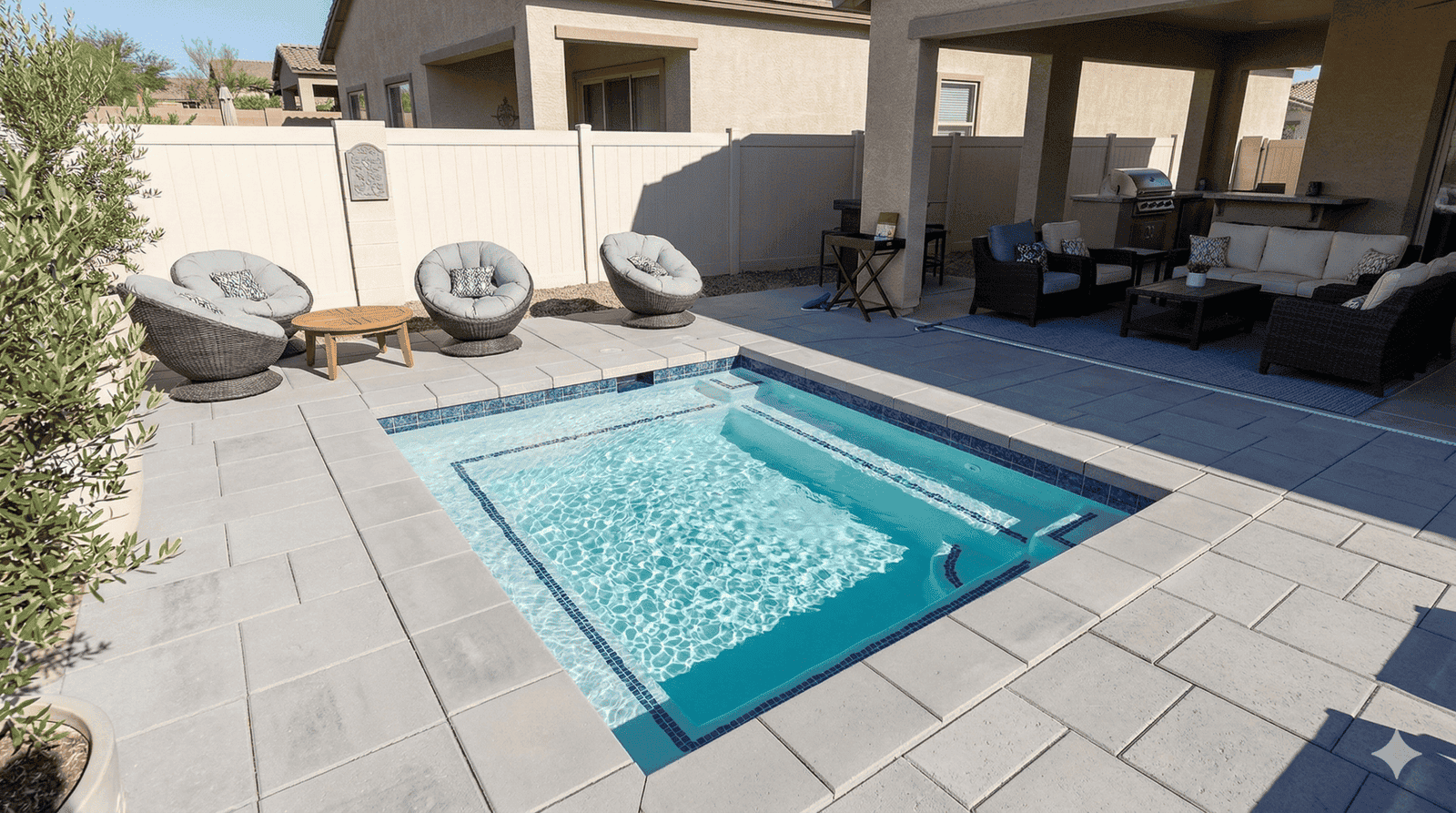
Coping you can walk on in July
Coping is the cap that runs around the edge of your pool — the part you sit on, grab when you climb out, and walk on all summer. It is the only surface in the whole project your bare feet touch more than the water does.
And here is the good news that almost nobody puts in front of you before you choose: you can pick a material that stays cool.
Travertine and light-coloured limestone run noticeably cooler underfoot than concrete or dark stone, because pale porous stone reflects the sun instead of storing it. In Temecula or Rancho Cucamonga in July that is the difference between a deck people stand around on and one everybody hops across.
Poured concrete is the least expensive option and it is structurally excellent — nothing second-rate about it. It just holds heat, and a lighter colour in the mix helps without eliminating the difference. If concrete is what the budget reaches, we will install it well, and you will have chosen it knowing what you chose.
So here is what we do at the estimate: we bring samples and you stand on them, in direct sun, for thirty seconds. Not in the shade, not indoors. It takes half a minute and it settles the question better than any description we could write.
And there is a middle road nobody offers unless you ask: concrete around most of the pool, with cooler stone only where people actually stand — the steps, the entry, the sunning area. You get the comfort where it is used and the price everywhere else.
Where people stand most
- The entry steps, where everybody gets in and out
- The shallow-end edge, where the kids hang on
- Wherever the loungers go
- The spa edge, if there is one
- The path between the door and the water
Tell us these at the estimate. If the budget is tight, this is where the cooler stone earns its money and the rest can be concrete.
Four materials
Pool coping materials, and what each one is really like
Four options cover almost every pool in this region. The differences that matter are heat, upkeep and price — in that order.
Travertine
The most requested stone in Southern California right now, and for good reason: it stays noticeably cooler than concrete, it has grip when it is wet, and it looks like it belongs in this climate.
It is porous, so it wants sealing roughly every two to three years. That is real upkeep and anyone who does not mention it is not telling you the whole story.
coolest underfoot
Light limestone and sandstone
Same principle as travertine — pale stone that reflects the sun instead of holding it. A slightly different look, often a little more uniform in colour, and the same cool surface in summer.
Also porous and also wants periodic sealing. Worth comparing side by side with travertine at the estimate, since the choice between them is almost entirely about appearance.
cool, more uniform
Brick and precast
Brick coping suits older pools and traditional houses, and it ages gracefully. Precast concrete units give you a clean, repeatable edge — the bullnose profile most people picture when they imagine a pool.
Both sit between concrete and natural stone on price, and both run warmer than travertine but cooler than a dark poured deck.
the middle ground
Poured concrete
Formed and poured in place, so it follows any shape your pool has, including a curved bench or a raised bond beam. The most affordable option by a wide margin and structurally excellent.
It does store heat, which is worth knowing before you pick it rather than after. A lighter colour in the mix helps, and so does putting cooler stone only where people stand.
most affordable
Our testimonials
Real experiences. Real results.
Hear it from the people whose backyards we worked in. Then read the reviews straight from our Google profile, below.
A customer on how the job went, start to finish.
Another customer, another backyard in Southern California.
Real reviews from real clients
Every one of them written by somebody whose pool we worked on, in Riverside, San Bernardino, Orange, Los Angeles or San Diego county. Several are in Spanish, because a good share of our customers are.
We would rather you read them before you call us than after.
Cleaning or replacing?
Waterline tile: when it cleans up and when it needs replacing
Most people call about tile because of the white crust. The good news is that sometimes it comes straight off — and we will tell you when that is your situation.
Water through this region is hard. That dissolved calcium comes out of solution at the waterline, where evaporation concentrates it, and it builds into the scale you are looking at.
In the early years it comes off. Bead blasting or a proper tile cleaning strips the calcium and gives you back the tile you paid for. That is a real service, it costs a fraction of replacement, and if that is what your pool needs we will say so rather than quote you something bigger.
Past a certain point the tile itself has changed. Years of scale and repeated aggressive cleaning etch the glaze. Once the glaze is gone the surface is porous, it grabs calcium faster than before, and each cleaning takes more out of it than the last. That is the pool where the tile looks cloudy again two months after a cleaning — and new tile is the thing that actually ends it.
There is also the simpler case: tiles that are loose, cracked, hollow-sounding or already missing. Those are not a cleaning question at all.
Send us a photo of the waterline, close enough to see the surface. We will tell you honestly whether you need a cleaning, a partial repair or a full replacement. Quoting the biggest of the three when you only needed the smallest is exactly how this industry earned its reputation.
Cleaning will probably fix it if
- The tile is chalky white but the glaze still shines underneath
- Every tile is firmly attached
- The grout lines are intact
- It has been more than a couple of years since the last cleaning
New tile is the answer if
- The scale comes back within months of a cleaning
- The tile looks dull or etched even where it is clean
- Tiles sound hollow when you tap them
- Tiles are cracked, loose, or already gone
- The grout is crumbling along the line
Six inches that change everything
Pool tile types: ceramic, porcelain, glass and mosaic
The waterline band is only six inches tall, which is exactly why people underthink it. It is also the strip your eye lands on every time you look at the pool.
Ceramic, the 6×6 workhorse
The standard waterline tile and still the most common choice in Southern California. Durable, an enormous range of patterns, and by far the friendliest on price.
It is what most pools in this region already have, and a fresh band of it makes an old pool look looked-after again.
the practical default
Porcelain
Denser and less absorbent than ceramic, which means it stands up better to the constant wet-dry cycling at the waterline and to hard water.
Costs more than ceramic and generally earns it on a pool that scales badly — which in this region is most of them.
better against hard water
Glass and mosaic
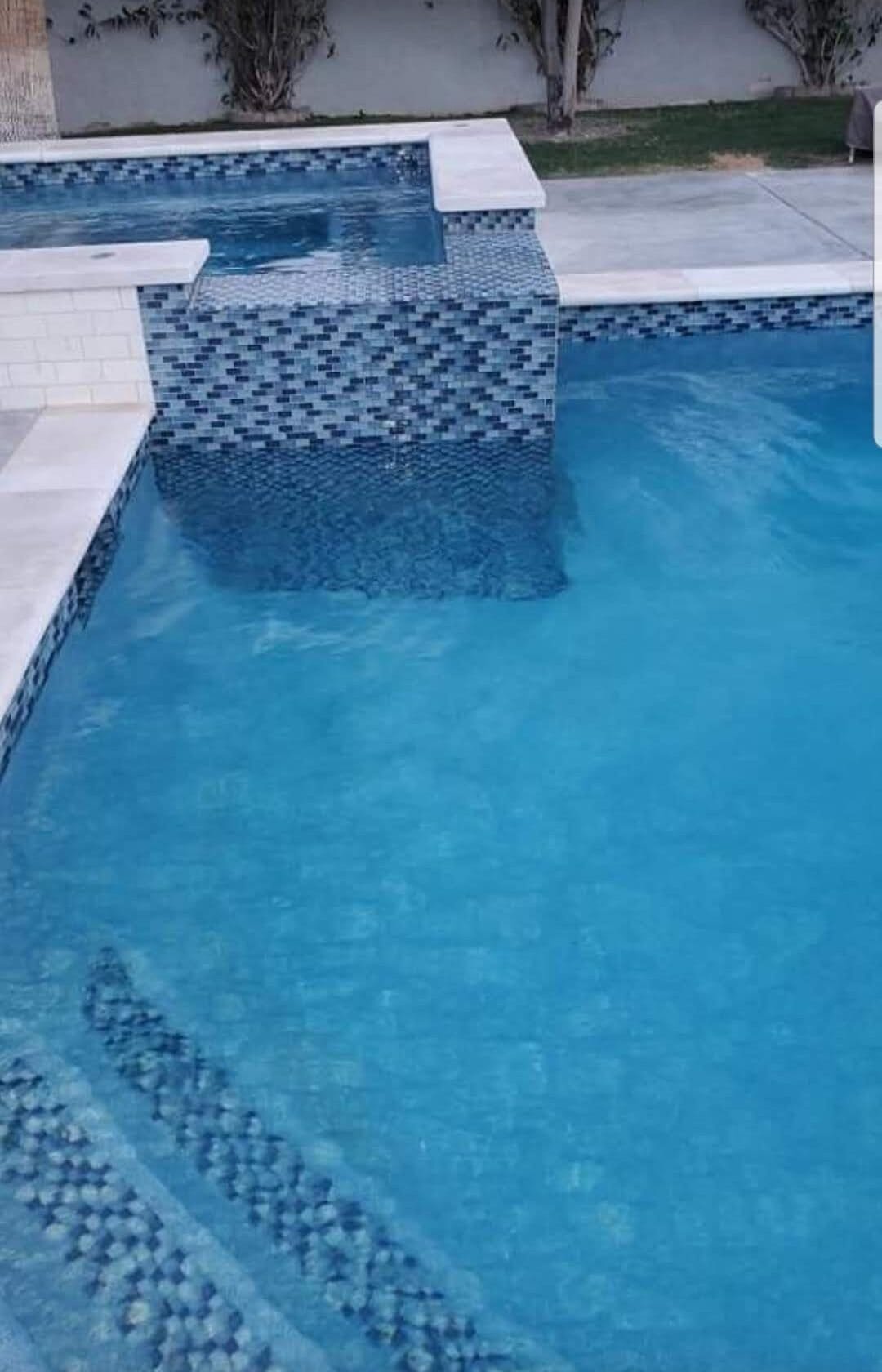
The finish that changes how a pool reads. Glass catches light and gives the waterline a depth ceramic cannot, and a mosaic band is the least expensive way to make a plain pool look custom.
It is the premium option and it wants a careful setter, because glass shows every imperfection in the substrate behind it. That is exactly the kind of work we would rather do ourselves than hand to anybody.
the biggest visual change
You pick the tile, not us. We work from a real catalog rather than one house line, so you choose from the tile and coping that actually exist in the sizes and colours you want — with samples in your hand, in your own daylight.
And if you are doing a new interior finish at the same time, bring the two decisions together. A waterline band that looks right against white plaster can disappear against a dark pebble finish, and that is far easier to sort out before anything is ordered.
Good news on the logistics
Can you replace pool coping without draining the pool?
Google gets asked this constantly, and the answer is better than most people expect: the coping yes, the waterline tile no.
Coping sits above the water, so in many cases it can be replaced with the pool level simply lowered a few inches rather than emptied. If your coping is loose or cracked but the interior finish and the tile are fine, that is a genuinely smaller and cheaper job than most people assume, and we do it that way whenever the pool allows.
Waterline tile is a different matter, because it sits exactly at the line and has to be dry to bond. Often it is enough to drop the level below the tile band rather than drain the whole pool, but it does go out of service for the job.
And one piece of arithmetic worth knowing. If you are resurfacing anyway, the tile has to come off regardless, because the old interior finish is chipped out right up to it. At that point you are paying for the tile and the setting, not for the demolition and the drain a second time — which is why tile is so often done alongside a new surface.
The reverse is also true and we will say it out loud: if your interior finish has five good years left, nobody should talk you into redoing it just because you wanted new tile. Those are separate decisions and you are allowed to make them separately. We will quote the tile on its own.
Why coping comes loose in the first place
Almost always the joint, not the stone. Between your pool deck and the coping there is a flexible expansion joint — the mastic — and it is there because concrete moves: with heat, with ground settling, and in this part of California with seismic activity.
When that joint dries out and cracks, water gets under the coping. It works its way in, expands on cold nights, and lifts the stones over a few seasons.
Replacing coping without replacing that joint is doing the job twice. We reset it as part of the work, every time, and it is a line item you can see in the quote.
What it costs
How much pool tile and coping replacement costs
We measure the perimeter — the distance around the edge of your pool — and quote the job after seeing it. Here is how the options compare.
| What you are having done | How it is priced |
|---|---|
| Waterline tile replacementOld tile off, substrate prepared, new tile set and grouted | quotedafter we measure |
| Coping replacementOld coping out, new coping set, expansion joint reset | quotedafter we measure |
| Tile and coping togetherThe usual combination, and cheaper than doing them a year apart | quotedone project, one price |
| Glass or mosaic waterlinePremium tile, more careful setting | quotedper project |
| Bundled with a new interior finishThe tile has to come off for resurfacing anyway | best valuesee resurfacing |
We do not publish prices for tile and coping. The number depends on your city, the material you choose, how we get into the yard, and what we find behind the old tile. You get one fixed number in writing after Oscar has come out and measured it — free, and that number does not move afterwards.
Where to start if the budget only reaches one thing
Tile alone is one of the least expensive things you can do to a tired pool, and one of the most visible. If the budget only reaches one item this year, this is usually the one that changes the most for the least.
You will also see much larger figures published for this work. Those are generally full remodels where tile and coping come with a new interior finish, new decking and equipment. If all you need is the tile and the coping, you should be quoted for the tile and the coping.
Financing is available. Ask about it when you call — it is worth knowing your options before you pick the material, because the difference between concrete and a cooler stone is usually smaller than people expect once it is spread out, and it is the part of the pool your feet live on.
Why we do not publish a rate per foot
Access first — a backyard we can reach with a truck is a different week than one where every load of broken coping leaves through a side gate by hand. Then material: stone costs more in some markets than others, and travertine is not priced the same everywhere. And the drive matters when a crew is on your property for days.
A contractor who quotes a flat per-foot price over the phone without asking where you live is either padding it to be safe or will revise it later. We would rather see the pool and give you one real number, in writing.
What happens, in what order
How a tile and coping job goes
Four steps, and you see the substrate before anything gets covered back up.
Step 1
Measure and choose
Free, at your house. We measure the perimeter, look at the existing joint and the bond beam, and bring tile and coping samples you can hold — and stand on, in the sun.
Step 2
Fixed price in writing
The exact tile and coping, the linear feet, the expansion joint included, and what is not in the number. You keep a copy before anything comes off. Ask about financing here.
Step 3
Remove and inspect
The old tile and coping come off and the bond beam underneath gets looked at properly. If there is anything behind it — a cracked skimmer throat, a fitting that should not be buried again — you see a photo and approve the fix before we cover it.
Step 4
Set, grout, seal
New tile set and grouted, coping laid and mortared, the expansion joint reset with fresh mastic, and natural stone sealed before we leave.
How long it takes
Tile only: a few days. Drop the water below the line, strip, set, grout, refill.
Coping only: usually under a week, and often without emptying the pool.
Tile and coping together, or bundled with a new interior finish: one to four weeks, depending on the material. Natural stone also needs its sealer to cure, which is a day nobody can rush.
We tell you which one yours is at the estimate, and we would rather say three weeks and finish in two.
Not sure whether it is the tile or the surface?
Sometimes what bothers people about a pool turns out to be the waterline, and sometimes it is the finish underneath. There is a table on our services page that matches what you are seeing to what it usually is.
Written guarantee on our workmanship
If something fails because of our workmanship within the first year, we come back and repair it. No cost, no argument — and it is in writing before we ever start, not promised verbally at the door.
Real work, real results
Recent work around the Inland Empire
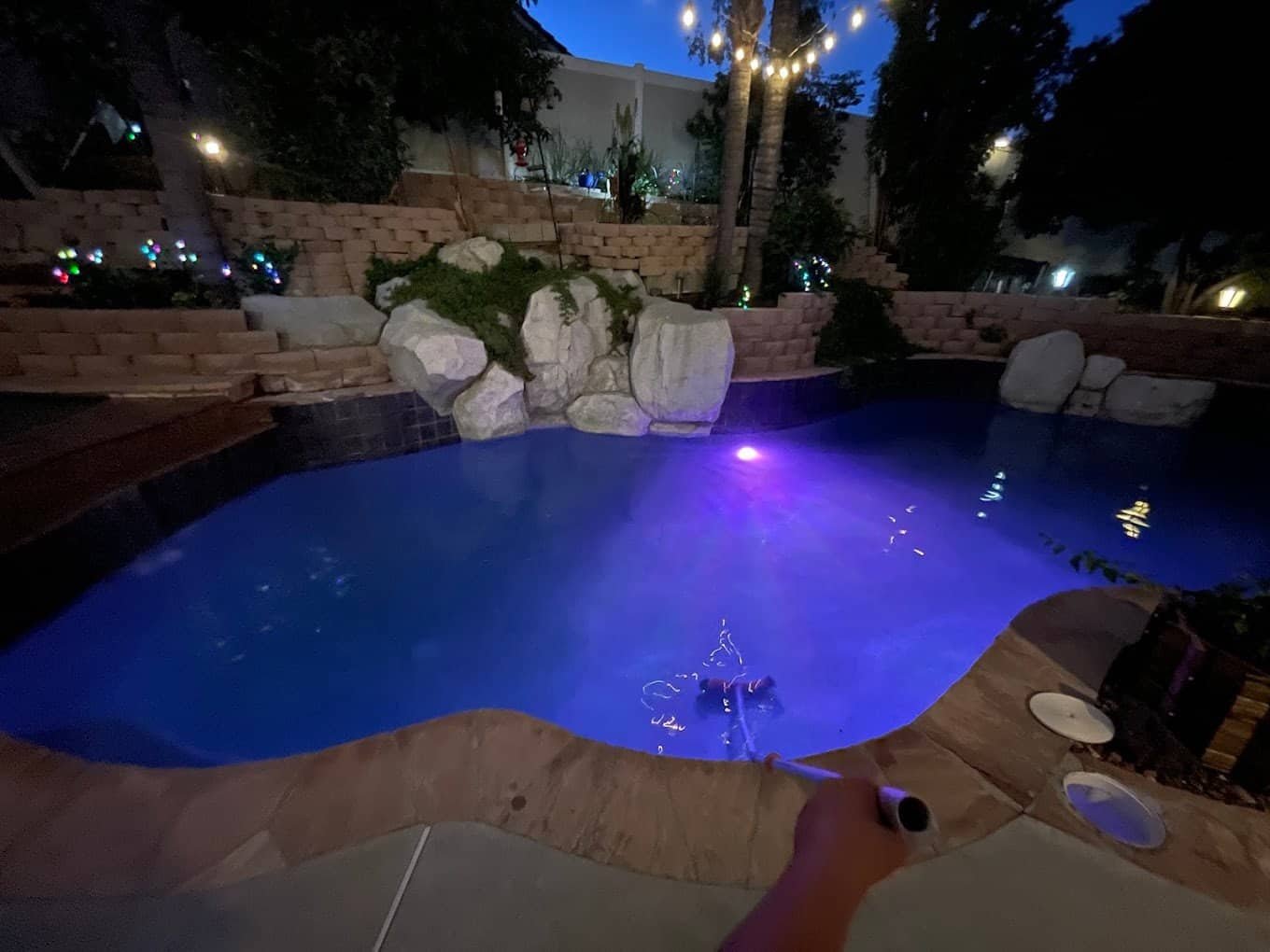
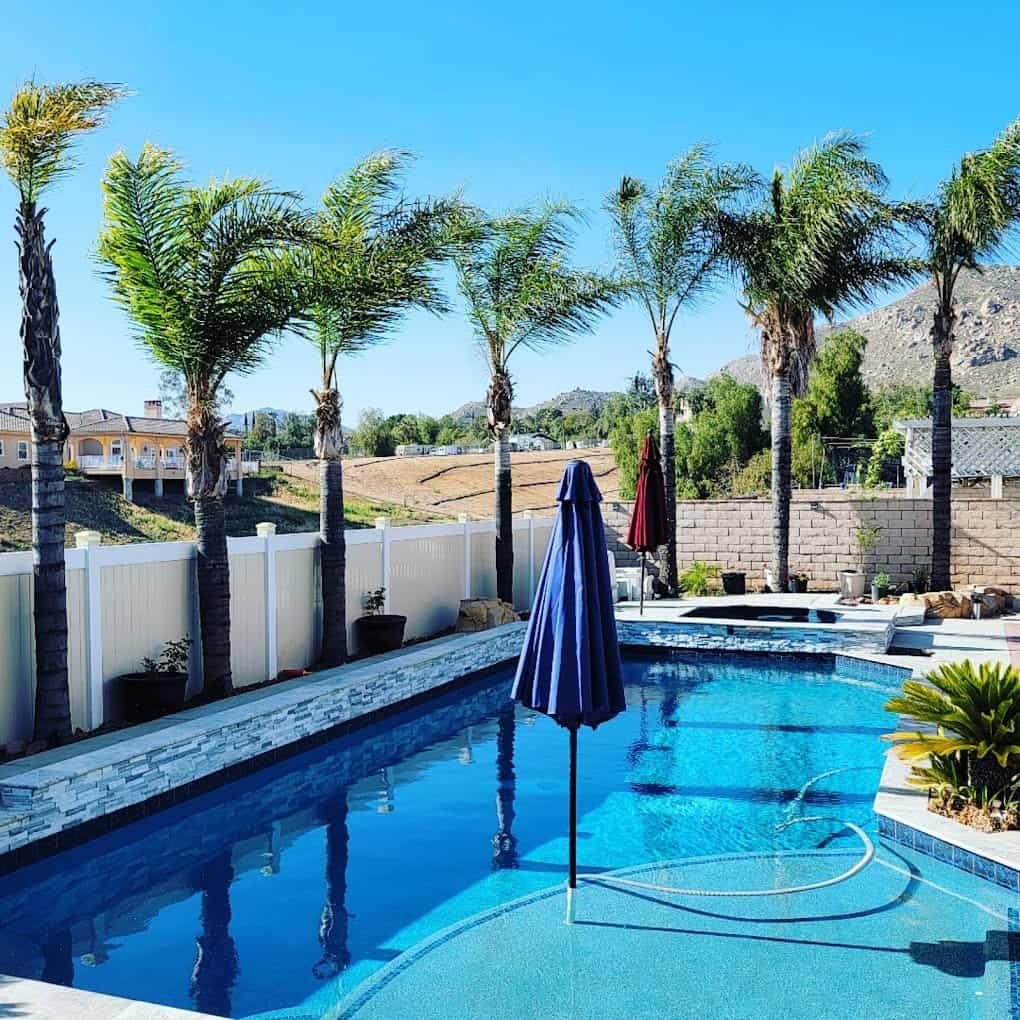
No stock photography — every project shown here is one of ours, in a real backyard.
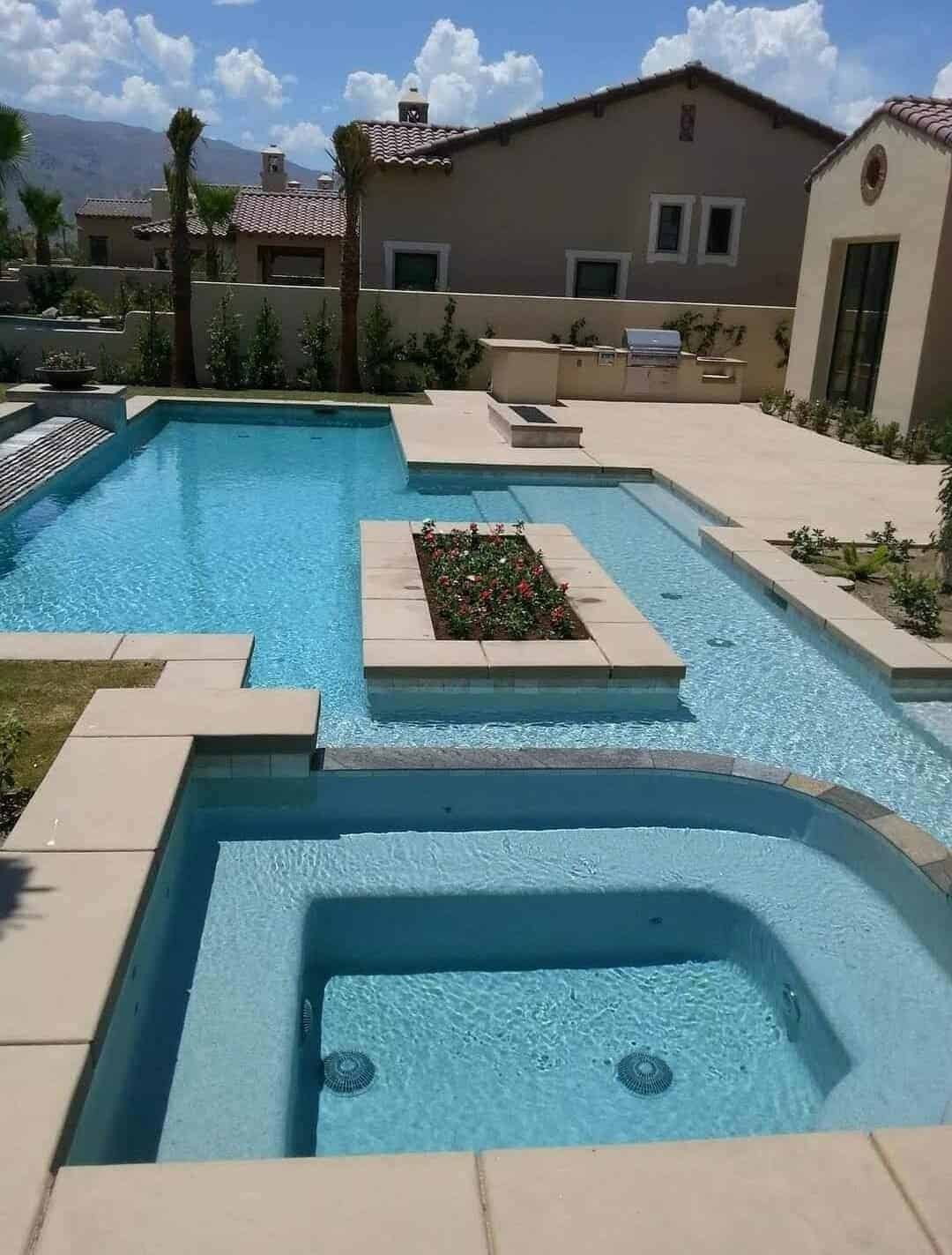
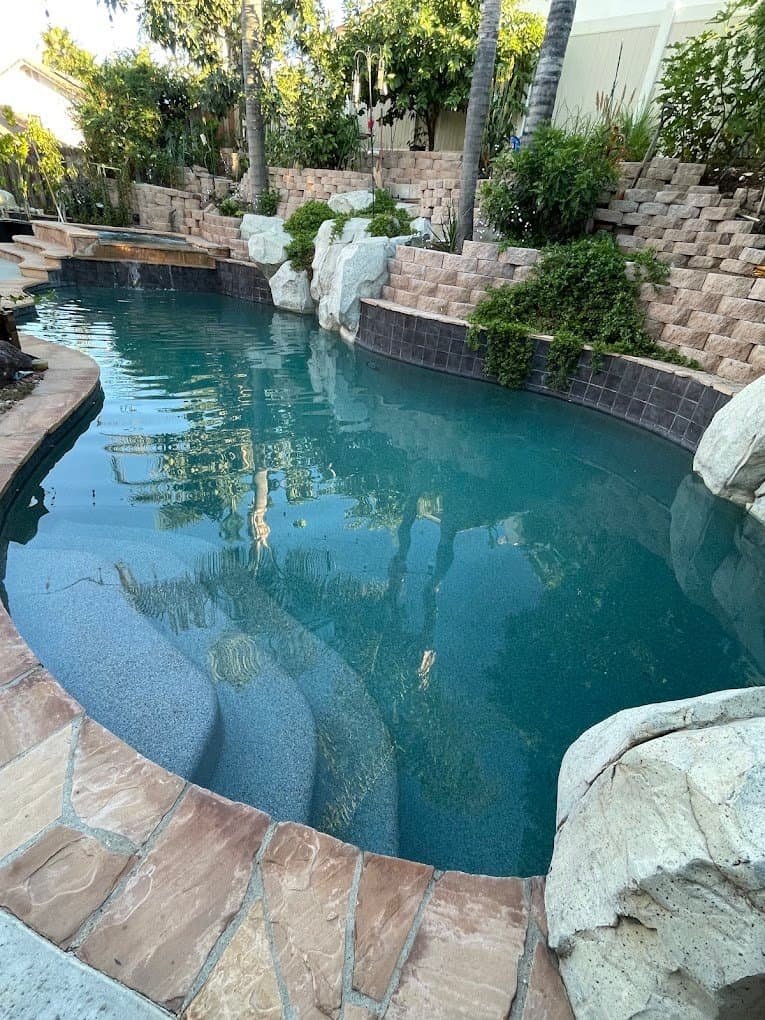
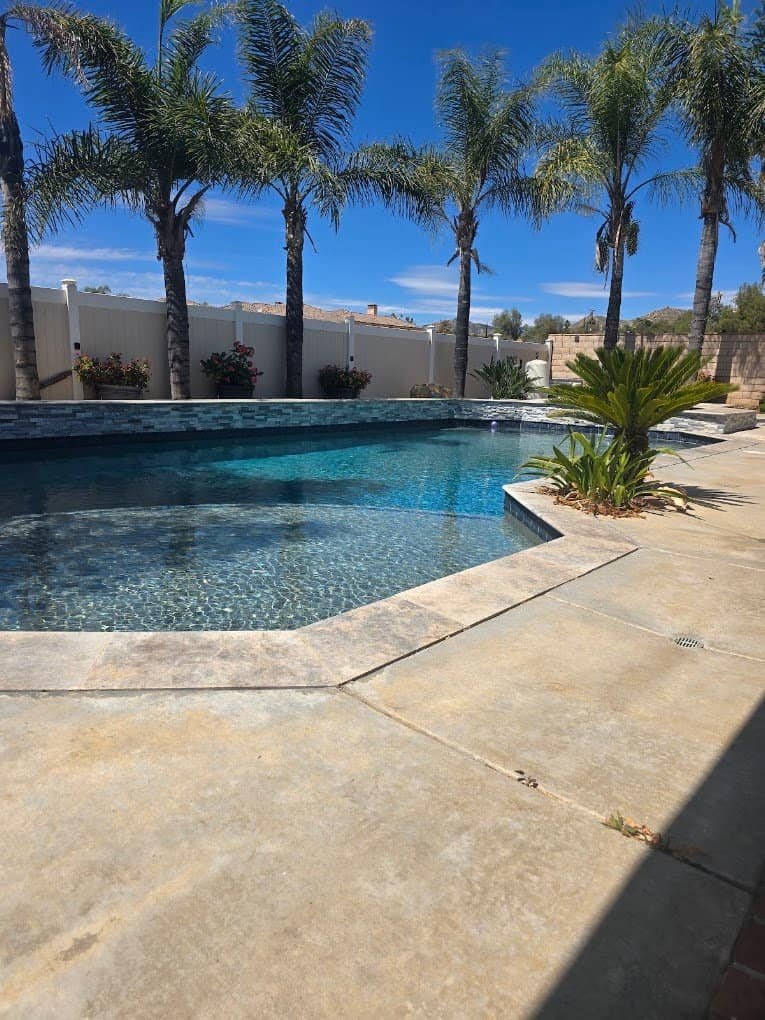
off your first remodeling or new construction project
For every new customer, on top of whatever the quote already says — your first pool remodeling or new pool construction project with us. Veterans and active-duty military, always. And ask about financing while you are at it. Just mention it when you call.
Where we work
Pool tile and coping replacement in Riverside, San Bernardino, Orange, Los Angeles and San Diego counties
We are based in Riverside County and we replace tile and coping across five counties. Hard water is the common thread through all of them — it is why the waterline is the first part of a pool to look its age, no matter how well the pool is kept.
Riverside County
Riverside, Hemet, Murrieta, Corona, Moreno Valley, Temecula, Menifee, Perris, Lake Elsinore, Eastvale
San Bernardino County
Redlands, Rancho Cucamonga, Ontario, Fontana, Chino Hills, Upland, Rialto, Highland, Yucaipa
Orange County
Anaheim, Irvine, Orange, Yorba Linda, Fullerton, Tustin, Brea, Villa Park
Los Angeles County
Pasadena, Glendora, Whittier, Claremont, San Dimas, La Verne, Arcadia, Covina
San Diego County
Carlsbad, Oceanside, Vista, San Marcos, Escondido, Encinitas, Fallbrook
The practical questions
Pool tile and coping questions we get asked
Most of these are the ones Google itself shows when you search pool tile or pool coping anywhere in Southern California.
How much does it cost to replace pool tile and coping?
We do not publish a price for this work, because it is not the same in every city or every backyard. Your number depends on your city, the material, the access to the yard and what is behind the old tile. It gets fixed in writing after Oscar has measured it, and the visit is free.
One thing worth knowing: most of the big figures published for this work are full remodels, where tile and coping come with a new interior finish and decking. If all you need is the tile and the coping, you should be quoted for the tile and the coping.
What type of tile is best for pool coping?
Coping and waterline tile are two different things, and the distinction matters when you compare quotes. Coping is the cap around the edge of the pool, the part you sit and walk on. Waterline tile is the band of tile at the water’s surface.
For coping, the honest answer is that porcelain pavers and natural stone both work, and the deciding factor in our climate is usually how hot the surface gets. Travertine and light limestone stay noticeably cooler underfoot than poured concrete or dark stone, which is why they are the two we recommend most around here.
For the waterline, porcelain holds up best against hard water because it absorbs almost nothing, so calcium sits on the surface instead of soaking in.
What are the best stones for pool coping?
Travertine first, for this part of California. It is the one you can stand on barefoot in July, it does not get slick when it is wet, and it reads as a finished edge rather than a poured one.
Light limestone and light sandstone are the close second, for the same reason — pale, matte stone reflects heat instead of holding it.
What we would steer you away from in an inland yard is dark stone, however good it looks in the showroom. Dark surfaces store heat, and your pool deck is not a showroom in July. Bring your hand to the sample in the sun before you decide — we will hold it there with you.
What is the most affordable option for pool coping?
Poured concrete, and we do install it. It is the least expensive edge you can put on a pool and it is perfectly sound work.
The trade-off is heat: concrete gets hot under the inland sun, and that is the one thing you cannot fix later without redoing the edge. So if the budget points to concrete, consider the middle road a lot of our customers take — concrete around most of the perimeter and a cooler stone on the two or three sections where people actually stand: the steps, the shallow end, the side the chairs face. It costs a fraction of doing the whole edge in stone, and it is the part your feet notice.
Also worth asking about financing before you settle on the material, because the gap between concrete and travertine is usually smaller than people expect once it is spread out.
Can you replace pool coping without draining the pool?
The coping, usually yes. The waterline tile, no.
Coping sits above the water, so most of the time we only need the level dropped a few inches. Waterline tile sits right at the surface and the substrate has to be dry for the new tile to bond, so the water goes below the line for that part — not the whole pool emptied, just below the line.
This is exactly why doing the two together makes sense: the water only has to come down once.
Do you offer financing?
Yes. Ask about it when you call and we will walk you through the options.
Ask before you pick the material rather than after. Coping is the one decision on a pool that your feet live with every summer, and plenty of people end up with the stone they actually wanted simply because they asked early.
Can my waterline tile be cleaned instead of replaced?
Often, yes — and we will tell you when. If the glaze still shines underneath the white, a cleaning gets your tile back for a fraction of the cost. That is a real answer and some of the time it is the right one.
What tells you the tile is past cleaning is when the calcium comes back within a couple of months, or the tile looks dull in the spots that are already clean. That dullness is the glaze gone, and once it is gone each cleaning takes a little more of what is left.
Send us a close-up photo of the waterline and we will tell you which one you have, including if the answer is that you do not need us yet.
Why does coping come loose in the first place?
The expansion joint. There is a deliberate gap between the coping and the concrete deck, filled with a flexible mastic, and it exists because the deck and the pool shell move at different rates — with heat, with ground movement, with time.
When that mastic dries out and cracks, two things follow. Water gets underneath, and the deck starts pushing directly on the coping instead of against a cushion. That is what lifts stones and cracks them.
We reset the expansion joint as part of every coping job, and it is a line item you should look for on any quote you get. It is cheap, it is invisible, and leaving it out is why some coping jobs fail in three years.
How long does it take?
Tile only, a few days. Coping only, usually under a week. Both together, or bundled with a new interior finish, one to four weeks depending on the material — natural stone also needs its sealer to cure, and that is a day nobody can rush.
You get told which one yours is at the estimate, and Oscar sends you an update every day the crew is there.
Should I do the tile and coping while I resurface the pool?
If you are resurfacing anyway, yes — and this is the one piece of timing advice that genuinely saves money. The waterline tile has to come off for a resurfacing regardless, and the water is already down. Doing the tile then costs a fraction of doing it as its own job a year later.
The reverse is also true, and we will say it: if your interior surface is fine and only the edge bothers you, do the edge. You do not need a full remodel to fix a waterline. And if the surface is the part that is tired, replastering is its own conversation.
Do you need a permit for tile and coping work?
We check what applies to your address before anything starts, and we tell you at the estimate. Requirements are not the same in every city, so rather than guess on a web page, we find out for your street.
If anything needs filing we handle it, and you get that timeline in writing separately so you always know which part of the schedule is ours and which part is the city’s.
Is the work guaranteed?
Yes — a written one-year guarantee on our workmanship, handed to you with the paperwork rather than promised verbally.
We are also a licensed California contractor, CSLB #1148412. You can look that number up at cslb.ca.gov and see the status yourself in about thirty seconds. We would encourage you to do that with every contractor who gives you a quote, including us.
¿Hablan español?
Sí. Oscar y su equipo hablan español. Llame, escriba o mande fotos en el idioma que prefiera y le contestamos en el mismo.
Get your free tile and coping estimate
Send a close-up photo of the waterline and one of the edge. That is usually enough for us to tell you roughly where you stand. Free estimate, fixed price in writing, financing available — and we will bring samples you can stand on in the sun before you choose.